IT Asset Recovery

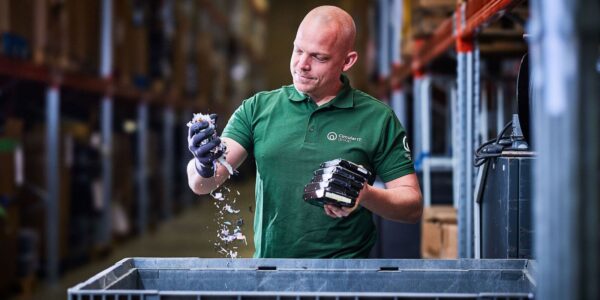
Our hard drive destruction service shreds hard drives to particles of 6 mm or smaller and SSDs to under 10 mm². That puts them at DIN 66399 security levels H5 and E5.
Request a free quoteCircular IT group does the work at your premises with a mobile shredder, or at our facility in East Kilbride, near Glasgow. Each drive is logged by its serial number before it is destroyed, and you receive a certificate of destruction for each one.
At our facility, a drive that still works is erased with Blancco before it is shredded. This is the order the National Cyber Security Centre recommends for drives that have held sensitive data.
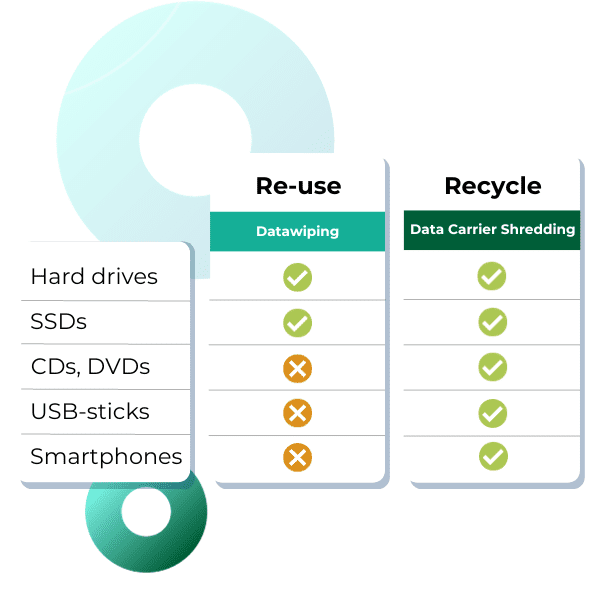
A working hard drive does not have to be shredded to be safe. Certified data erasure to NIST 800-88 removes the data and keeps the drive in use, with its resale value. Physical destruction is the answer when:
If you are not sure which route fits, our page on data destruction compares erasure and shredding side by side.
DIN 66399, also published as ISO/IEC 21964, sorts data carriers by type and sets seven security levels for each. The higher the level, the smaller the particles the shredder may leave.
H5 and E5 belong to the standard’s highest protection class, class 3.
For devices that have held more sensitive data, the NCSC guidance on secure sanitisation asks for destruction to particles of 6 mm or less. It asks for the data to be erased first.
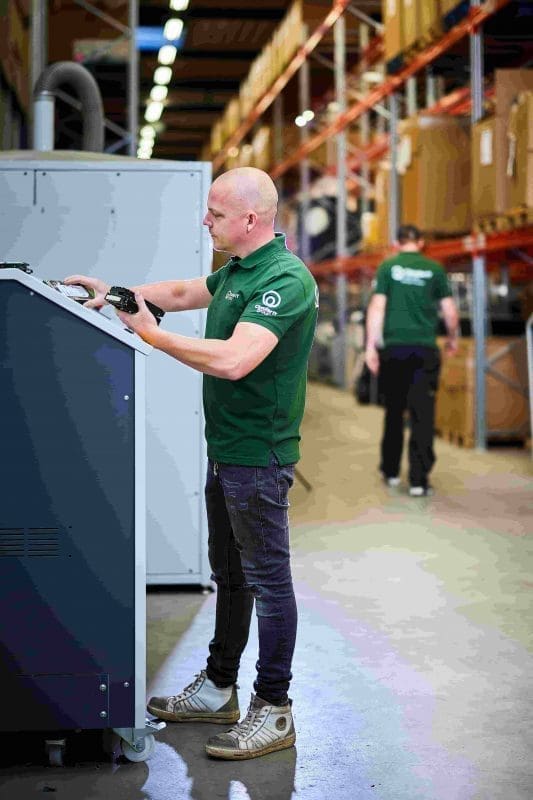
Our mobile shredding service covers the UK and Europe and comes to your building. Drives are logged and shredded at your site, so no intact drive leaves the premises. A typical job is done within a few hours, and you receive the certificates of destruction straight after. High-security government organisations and defensive sites already trust this option for their drives. We also destroy drives on site for organisations elsewhere in the world. More about the visit is on our on-site data destruction page.
We count and register the drives at collection, before they leave your site, and bring them to our facility in East Kilbride in our own secure, GPS-tracked vehicles. The chain of custody is documented from your site to the shredder. Collections start at 10 devices, for registered businesses and organisations.




On an SSD the data sits on memory chips spread across the circuit board, not on a disk like HDDs. Physical destruction has to break every one of those chips. That is why DIN 66399 puts SSDs in category E, with a far smaller particle limit than hard drives.
Our E5 shredder grinds SSDs to particles under 10 mm². This covers drives that still work and drives that have failed, so a dead SSD that cannot be erased is still destroyed to the same level.
Shredded metal and plastic are separated and sent for IT recycling under our zero landfill policy.
Each drive gets a certificate of destruction with its serial number, the method used and the date. You also receive an asset-level report that lists every drive by serial number, with a summary by device type. After an on-site job, you have the certificates before our vehicle leaves.
The certificate is the evidence an auditor or the ICO asks to see. Under UK GDPR you need to be able to show how personal data was disposed of. The report also lets you check that record against your own asset register.

Quote
Tell us how many drives you have, if they are loose or still in equipment, and if you want them destroyed on site or at our facility. The quote is free.

Booking
We agree on a date for the mobile shredder or for the collection.

Registration
Each drive’s serial number is scanned and recorded before anything is destroyed.

Destruction
Hard drives are shredded to H5 and SSDs to E5. At our facility, working drives are erased with Blancco first.

Certificate and recycling
You receive a certificate for each drive, and the shredded material goes for recycling.
Our UK operation in East Kilbride has handled IT disposal since 1996.


The waste hierarchy for IT hardware: from prevention to recovery
The waste hierarchy comes up in most conversations about sustainable IT, but it only tells half the story. Below, we cover what the hierarchy actually says, how the more detailed 9R framework builds on it, and what both mean for the laptops, desktops and servers your organisation runs.

Supporting Digital Inclusion in the UK: 24 Laptops for The King’s Trust
Circular IT group were proud to refurbished 24 laptops for The King’s Trust, helping young people access technology and supporting digital inclusion in the UK.

Laptop disposal, destruction or donation: what’s the safest choice?
Getting rid of an old laptop looks like a simple decision, but the safest route depends on the condition of the device and the data stored on it. Below you'll find the right approach for each situation, and when certified laptop destruction is genuinely the answer.
The price depends on the number of drives, whether we shred on site or at our facility, and where your premises are. We price per drive, or as part of a wider IT asset disposition project, and the quote includes the secure transport and the certificates. Where working equipment has resale value, it can be erased and bought back through IT asset recovery, which reduces the overall cost.
Yes. With on-site shredding your staff can watch each drive go into the mobile shredder and check the serial numbers against the certificates before we leave.
Drilling or hammering a drive leaves pieces of platter or chip far larger than the particle size the NCSC sets for sensitive data. It also leaves no record of what was destroyed. A shredding service brings the particles down to a known size and gives you a certificate for each drive. Our guide to the dos and don’ts of hard drive destruction goes into more detail.
Yes. We collect the laptops, desktops, servers, storage systems, and NAS devices, then our team removes the hard drives and SSDs before destruction, so nothing needs dismantling beforehand.
Yes. For a full data centre or server room, our data centre decommissioning service covers de-racking, transport, erasure and shredding of the drives, on site or at our facility.
Yes. Our facility is in East Kilbride, near Glasgow, and the mobile shredding service covers the UK and Europe. Collections and on-site visits are arranged from the same team.
Yes, alongside our UK centre, we also have facilities across Europe providing on-site and off-site shredding. As well as our European coverage, we have extensive experience managing global ITAD programmes, coordinating trusted partners across multiple countries to deliver secure shredding for complex international projects.

Paul McHugh
Quotes for hard drive destruction come from our UK team in East Kilbride, led by Paul McHugh, Managing Director (UK). Use the form below, or call +44 845 206 8100.
"*" indicates required fields