HomeNewsWhat Is ITAD? IT Asset Disposition Explained
April 07, 2025
What Is ITAD? IT Asset Disposition Explained
IT Asset Disposition
blog
Written by the Circular IT group ITAD team. Updated September 2026.
IT Asset Disposition (ITAD) is the managed process of retiring IT equipment an organisation no longer needs: collecting it, erasing or destroying the data on it, then reselling, donating or recycling the hardware, with a certificate and an asset-level report for every device. ITAD differs from IT recycling because it starts with data security and value recovery and treats recycling as the last step, not the first.
Circular IT group runs ITAD for organisations in the UK, Europe and worldwide, from single-office clearances to multi-country projects. See our IT Asset Disposition services.
Businesses regularly accumulate outdated IT equipment, from laptops and servers to smartphones and storage devices. Simply throwing these assets away is not an option due to data security risks, environmental impact, and lost residual value.
ITAD, short for IT Asset Disposition, helps organisations securely and sustainably manage retired IT hardware. In this guide, we explain what ITAD means, how the process works, and why it is important for security, compliance, and sustainability.
ITAD stands for IT Asset Disposition, an umbrella term for all processes involved in the secure, compliant, and sustainable handling of retired IT equipment.
The goal of ITAD is not simply to dispose of old hardware, but to maximise value recovery while minimising security risks and environmental impact.
Unlike standard IT recycling, ITAD also focuses on data security, regulatory compliance, asset tracking, and lifecycle management. This makes ITAD particularly important for organisations handling sensitive information or operating under regulations such as GDPR.
How does ITAD differ from recycling?
Although recycling is part of ITAD, the two are not the same. IT recycling mainly focuses on dismantling equipment and recovering raw materials, while ITAD takes a broader approach that includes data security, reuse, compliance, and value recovery.
The table below highlights the main differences:
ITAD
IT Recycling
Includes secure data destruction
Focuses mainly on material recovery
Prioritises reuse and refurbishment
Typically dismantles equipment
Supports resale and value recovery
Limited residual value recovery
Includes compliance reporting
Limited compliance focus
Maintains chain of custody
Not always included
Supports circular IT strategies
Focused on waste processing
Why is IT Asset Disposition important?
There are several reasons why ITAD is an indispensable part of a modern IT strategy:
1. Data security
Retired hardware often contains confidential data. Think customer records, financial information, and emails. A reputable ITAD partner provides certified data sanitisation, typically using industry-standard tools, like Blancco, to erase data. Where reuse is not required or erasure is not possible, the drives are physically destroyed by shredding, either at the ITAD provider’s facility or on the client’s premises with a mobile shredder.
Whichever method is used, a good ITAD partner maintains a chain of custody and issues a certificate of erasure or destruction for every device. Erasure follows the NIST 800-88 standard.
2. Laws and regulations
GDPR compliance is mandatory when handling personal data, including during hardware and e-waste disposal. Certified ITAD providers deliver high-quality services that comply with GDPR and e-waste destruction regulations, and issue audit-ready reports after destruction.
3. Environment and sustainability
Discarded IT equipment can contain harmful heavy metals, like lead, mercury and cadmium. These substances can harm human health and the environment if mishandled. That is why it is so important to work with a certified ITAD partner that processes e-waste correctly and keeps materials in the circular economy through controlled reuse, repair and responsible recycling.
The ITAD market has evolved into a fast‑growing global industry, driven by rising data‑security demands, stricter compliance requirements and the increasing volume of end‑of‑life IT equipment. More organisations now outsource secure data wiping, refurbishment and compliant recycling, accelerating the sector’s professionalisation.
Market research valued the global ITAD industry at $14.6 billion in 2020, with growth expected to reach $24.5 billion by 2026. Although the pandemic temporarily slowed activity due to supply‑chain disruption, long‑term demand continues to rise as businesses prioritise GDPR compliance, ESG performance and circular IT strategies.
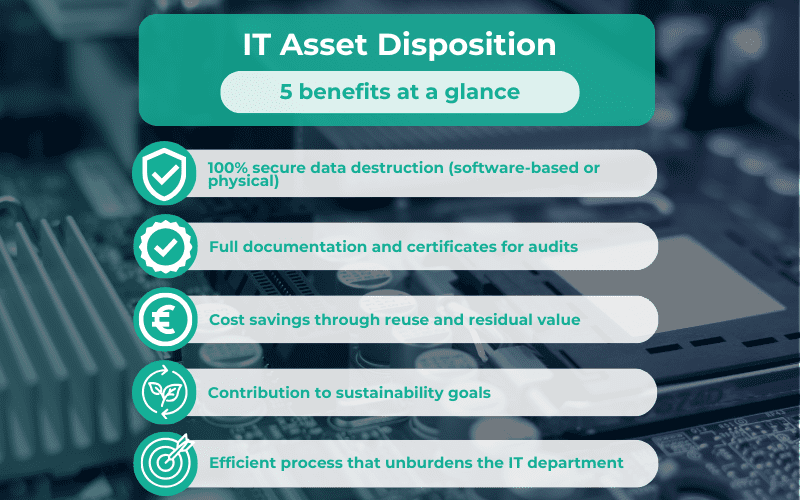
What are the benefits of ITAD?
Want to know the impact of reuse or circular IT solutions within your organisation? Circular IT group offers a handy sustainability calculator providing you with quick insight into potential savings in terms of CO₂ emissions, e-waste, and energy consumption. So you can see exactly what extending the lifespan of IT hardware can achieve.
What does the ITAD process look like?
The ITAD process usually consists of the following steps:
Inventory of hardware
Which devices are depreciated or obsolete?
Collection or disposal
The hardware is safely collected, often with trackable transport.
Data destruction
All storage media are erased or destroyed. For example, with certified software or physical shredders.
Testing and evaluation
Equipment is checked for operation and reuse potential.
Reusable items are refurbished
Think upgrades, minor repairs for sale and/or donation.
Recycling of non-reusable parts
In an environmentally friendly way, at certified partners.
Reporting and certificates
You receive documentation of what happened to your hardware, which is important for your internal administration or compliance.
Circular IT group carries out this process worldwide for both medium-sized and large organisations, always with attention to data, environment, and transparency.
What hardware can be sold?
IT companies, such as Circular IT group, buy used business devices. Before selling, they ensure the hardware is complete and functioning properly. Devices that can be sold include:
No, ITAD isn’t legally mandatory, but using a certified provider is the most reliable way to meet GDPR data erasure requirements and WEEE-compliant e-waste disposal, with audit-ready proof.
Yes, some organisations choose to donate hardware or the hardware’s residual value to charity. This can be part of your corporate social responsibility (CSR).
This varies by organisation and the amount of equipment. Small processes can be completed within a few days, larger projects often take several weeks, depending on inventory, logistics and processing.
Companies typically initiate the ITAD process when hardware reaches the end of its lifecycle, becomes outdated or no longer meets performance or security requirements.
Common triggers include technology upgrades, employee offboarding, security incidents, lease expirations, data‑centre decommissioning, mergers or restructuring, and sustainability initiatives.
Regular inventory audits also often reveal unused or redundant devices that can be securely retired, resold or recycled.
The waste hierarchy for IT hardware: from prevention to recovery
The waste hierarchy comes up in most conversations about sustainable IT, but it only tells half the story. Below, we cover what the hierarchy actually says, how the more detailed 9R framework builds on it, and what both mean for the laptops, desktops and servers your organisation runs.
Laptop disposal, destruction or donation: what’s the safest choice?
Getting rid of an old laptop looks like a simple decision, but the safest route depends on the condition of the device and the data stored on it. Below you'll find the right approach for each situation, and when certified laptop destruction is genuinely the answer.
Third Party Maintenance: How to Keep IT Infrastructure Running for Longer
As the infrastructure gets older, the costs associated with renewing OEM support go up and refresh cycles can replace equipment that is still reliable, suitable, and trusted for its intended purpose.